Post-Renovation Cleaning Toronto: 2026 Homeowner's Guide

The Liberty Village condo that taught me what drywall dust really does

Two weeks after a Liberty Village condo owner finished her kitchen reno, she called us in tears. She had hired a contractor who promised "broom-clean handover." That phrase is in almost every contractor agreement in Toronto, and it sounds reassuring. It is also, as I have now learned the hard way, the single most expensive piece of language in the residential renovation industry.
She had moved her two cats back into the condo five days after the contractor pulled the last drop cloth. By day seven, both cats were coughing. By day ten, she had the worst sinus infection she'd had in a decade. By day twelve, she was wiping a damp microfiber cloth across the top of her fridge and finding a layer of fine grey-white dust thicker than a credit card. The kitchen looked clean. The countertops were clear. The floors had been swept. But every horizontal surface above eye level — every door frame, every light fixture, the inside of every kitchen cabinet drawer she hadn't opened yet, the slats of every closet door — was holding onto a film of drywall dust that had been settling, slowly and silently, since the day the contractor's compressor turned off.
That is the part nobody tells you about renovations in Toronto. The dust does not finish settling for two to three weeks. By the time it has finished settling, you have already moved back in, opened your windows, run your HVAC, fed your kids dinner on a counter that looks fine, and inhaled enough fine particulate to test the limits of your respiratory system. Post-renovation cleaning Toronto is not the same job as a deep clean. It is not the same job as a regular clean. It is its own category, and if you treat it like anything else you will regret it.
That Liberty Village job took us nine and a half hours with two cleaners, four passes per surface, two HEPA vacuum filter changes, and one full bottle of Bar keepers Friend on the stainless backsplash alone. By the time we left, the cats had stopped coughing. The owner texted me a photo of her bedside lamp the next morning — no dust on the bulb, no dust on the shade, no dust on the nightstand. That was the first text message I screenshotted and saved to a folder on my phone called "the why."
This guide is about the why. If you have just finished a renovation in Toronto — or you are about to — this is the post-renovation cleaning service playbook I wish someone had handed me before my own first reno project. We will go through what the dust actually does, what your contractor's "final clean" actually covers (spoiler: less than you think), the room-by-room checklist we use, the specific tools and products that work, the ones that make things worse, the timing, the pricing, and the questions to ask before you hire anyone — including us.
Why post-renovation cleaning in Toronto is its own category
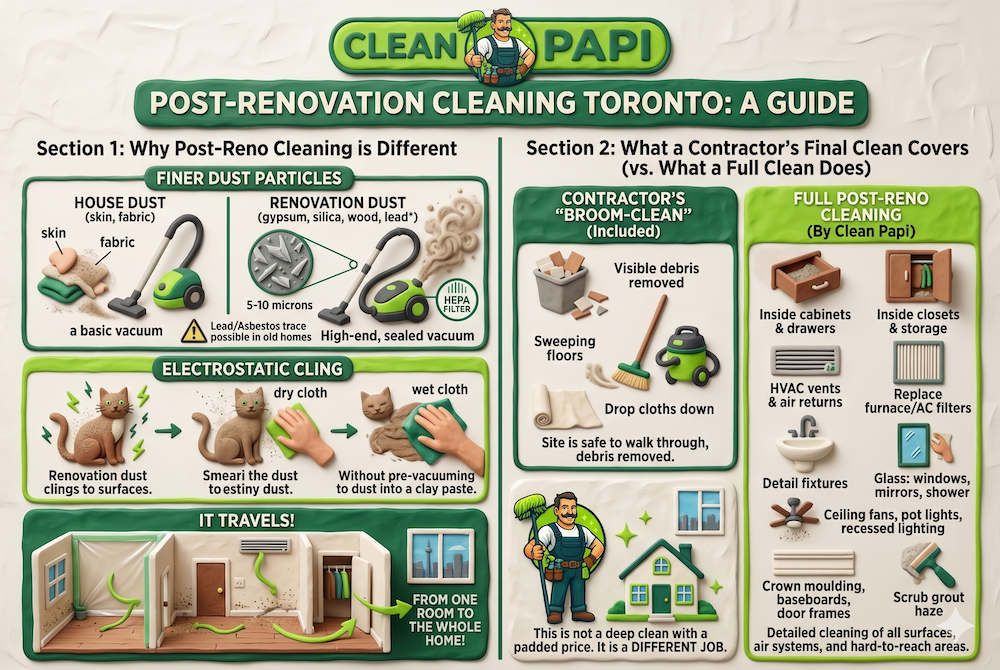
Renovation dust is not house dust. House dust is mostly skin cells, fabric fibres, and cooking residue, which is why a regular weekly clean handles it without much drama. Renovation dust is a totally different beast: gypsum (from drywall), silica (from concrete cuts and tile saws), wood particulate (from MDF, plywood, and finished hardwood), paint solvent residue, adhesive vapours that have settled, and — in older Toronto homes — sometimes lead paint particles or trace amounts of asbestos from old vermiculite insulation that was disturbed.
Three things about this dust matter for cleaning:
It is finer than house dust. Drywall dust particles can be as small as five to ten microns, which is well below what a typical big-box-store vacuum can capture and re-emit cleanly. A vacuum without a true HEPA filter will pick up dust at the floor level and aerosolize it back into the air at the exhaust, which means you are just moving the problem from the floor to the ceiling.
It is electrostatic. Drywall dust clings to surfaces in a way that house dust does not. Wiping it with a dry cloth will smear it. Wiping it with a wet cloth without first vacuuming will turn it into a thin gypsum paste that bonds to the surface and is twice as hard to remove on the second pass.
It travels. This is the part that catches people out. Even with poly sheeting taped over doorways and HVAC vents, a Toronto winter renovation will push dust through every crack the building has — under doors, around outlet covers, through the gap between baseboard and floor, into the bedroom closet you swore was sealed off. If your reno was in one room, your post-reno clean is for the whole condo or the whole house. There is no exception to this.
This is why we treat post-renovation cleaning as its own service line at Clean Papi, with its own checklist, its own product set, and its own pricing model. It is not a deep clean with the price padded. It is a different job.
If you want a refresher on how a deep clean differs from a regular clean before we get into the post-reno specifics, our deep cleaning vs regular cleaning guide walks through the comparison in detail.
What contractor "final clean" actually covers
I want to be fair to contractors here, because most of the ones we work with in Toronto are good people running tight margins. The "final clean" or "broom-clean handover" in their contracts is usually defined as:
-
Visible debris removed (chunks, offcuts, packaging)
-
Floors swept or shop-vac'd
-
Tools and equipment removed from site
-
Drop cloths and poly sheeting taken down
-
Site is "safe to walk through" What it does not include, and what people consistently assume it includes:
-
Wiping down any surfaces other than what's strictly necessary to install the next thing
-
Cleaning inside cabinets, drawers, closets, or any storage that was disturbed
-
Cleaning HVAC vents, air returns, or registers
-
Replacing furnace filters or AC filters that ran during demolition
-
Detail cleaning of new fixtures (sinks, faucets, tubs, toilets)
-
Glass — including windows, mirrors, and shower glass that picked up overspray or adhesive
-
Inside light fixtures, ceiling fans, or recessed pot lights
-
Door frames, baseboards, crown moulding, top of door casings
-
Scrubbing grout haze off new tile (this is its own specialty)
-
Any deep cleaning of bathrooms or kitchens that were not the focus of the reno but caught the dust anyway If your contractor includes any of the above in their final clean, treat it as a happy bonus and verify the work before you sign off and pay. Most do not, and that is not a knock on them — it is a different scope of work that requires different tools and different training.
The post-renovation cleaning checklist we use
Here is the actual room-by-room sequence our cleaners follow, in the order they follow it. This is the master checklist that lives in our cleaners app for every post-reno job in Toronto.
Top-down rule
Always start at the ceiling and work down. Gravity is the only physics that matters in post-reno cleaning. If you wipe the counters first and then dust the ceiling fan, you are going to wipe the counters twice. We do every room ceiling-down: ceiling fans and light fixtures, then crown moulding and door frames, then upper cabinets, then walls, then mid-height (counters, sills, switch plates), then low (baseboards, floors). One direction. No shortcuts.
Room 1: Whole-home dust capture (do this first)
Before any wet cleaning anywhere, the entire space gets HEPA-vacuumed top to bottom, room by room. We use Bissell HEPA-filtered uprights with the soft-brush attachment for delicate surfaces and the crevice tool for door frame tops, baseboard seams, and the gap between fridge and cabinets. The goal is to capture as much settled dust as possible while it is still dry. Once water touches it, it bonds.
This pass alone can take two to three hours in an 800-square-foot condo and four to six hours in a typical Toronto semi-detached. We change vacuum filter bags more often than usual — sometimes mid-job — because drywall dust packs them out fast.
Room 2: HVAC and air handling
This is the step that 90 percent of post-renovation cleans skip, and it is the single most important step for indoor air quality.
- Replace the furnace filter. Always. Even if it was changed before the reno started.
- Replace the AC filter if your unit has one. (Many Toronto condos have separate fan-coil units with their own filters — check yours.)
- Vacuum every supply register and cold-air return with the HEPA vacuum and crevice tool.
- Wipe the inside of each register vent with a damp microfibre cloth.
- For cold-air returns: pop the grille, vacuum inside the duct as far as the wand reaches, and wipe the grille front and back.
- If the renovation was extensive, recommend a professional duct cleaning. We don't do duct cleaning ourselves, but we'll tell you when it's worth booking one.
Room 3: Kitchen
Even if the kitchen was not the room being renovated, it will have caught dust. If it was the room being renovated, double everything below.
- Remove all items from inside cabinets and drawers (we will help with this if it is part of the scope).
- HEPA-vacuum inside every cabinet, every drawer, and every pantry shelf.
- Wipe inside surfaces with a damp microfibre cloth and our non-scented multi-purpose cleaner.
- Cabinet faces, handles, hinges — including the underside of upper cabinets where dust collects.
- New appliances: protective film removal, factory residue cleaned, manufacturer-guided cleaning of stainless steel (we use a non-abrasive stainless cleaner; never use Bar Keepers Friend on a brushed finish without testing).
- Range hood filter: removed, soaked, scrubbed, replaced.
- Stove vent: cleaned inside and out.
- Fridge: pulled out (we move it), back coil vacuumed, gasket cleaned, top of fridge cleaned, inside cleaned if requested.
- Dishwasher: filter removed and cleaned, gasket wiped, run an empty cleaning cycle.
- Backsplash: degreased and dust-wiped — Bar Keepers Friend on stainless, non-scented multipurpose on tile.
- Countertops: stone gets our non-scented granite-safe cleaner; quartz gets the same; laminate gets the multipurpose. Never use abrasives on any of them.
- Sink, faucet, garburator (if installed): polished. Hard water deposits removed.
- Floors: HEPA-vacuumed first, then mopped with our non-scented floor cleaner. Two passes if there is grout haze on tile.
Room 4: Bathrooms
- New fixtures: protective stickers and film removed, factory adhesive residue cleaned.
- Inside vanity cabinets: vacuumed and wiped.
- Toilet: bowl, tank exterior, behind the tank (we move it forward to access), bolt caps, base seal.
- Shower / tub: full deep clean with Waitbird steam cleaner on grout, soap scum, and any new caulk that needs to be polished without abrasion.
- Glass: streak-free, both sides if accessible.
- Mirrors: streak-free, frame cleaned.
- Vent fan: cover removed, inside vacuumed, cover washed and replaced.
- Floors: vacuumed, mopped, grout scrubbed where necessary.
- Tile-and-grout haze: this is its own thing. New tile installations need a cement-haze remover applied per the tile manufacturer's instructions. We follow the spec sheet that came with your tile.
Room 5: Bedrooms and closets
- Closets: empty if the homeowner can. Vacuum inside, top to bottom. Wipe shelves, rod, walls.
- Bed frames and headboards: HEPA-vacuumed, dust-wiped on hard surfaces, upholstery-attachment passes on fabric.
- Mattresses: if exposed during renovation, get a top-to-bottom HEPA-vacuum and a steam pass.
- Window treatments: blinds dusted slat-by-slat with a microfibre tool. Curtains laundered or steamed depending on fabric.
- Light fixtures and ceiling fan blades: cleaned individually.
- Floors: vacuumed, mopped or carpet-shampooed depending on surface.
Room 6: Living and dining
- Upholstery: HEPA-vacuumed with the upholstery attachment. We always move couches and chairs to clean underneath them. Always.
- Hard furniture: top, sides, undersides, drawers if applicable.
- Bookshelves: every book and item removed, shelves wiped, items dusted before replacement.
- Electronics and screens: screen-safe microfibre and electronics cleaner. No spray directly on screens.
- Hard floors: vacuumed and damp-mopped.
- Carpets: HEPA-vacuumed in two perpendicular directions; spot-treat anything that needs it.
Room 7: Windows and glass
Windows are last, after all the dust has been displaced from elsewhere, because cleaning windows first means cleaning them again at the end.
- Tracks: vacuumed first, then wiped.
- Sills: vacuumed and wiped.
- Glass: interior, exterior if accessible, frame cleaned.
- Screens: removed, vacuumed, rinsed if dirty.
Room 8: Final dust-settling pass
This is the pass nobody else does, and it is the one that tells you whether a cleaning company actually understands post-renovation work.
We come back the next morning. Or, if the schedule allows, we leave for two hours after the main clean is complete, return, and do a final pass on every horizontal surface. Why? Because there is always a slow-settling layer of fine dust that wasn't airborne yet during the first pass, and it lands overnight. The second pass is the difference between a post-reno clean that holds for a month and one that has visible dust again in 48 hours.
The tools and products that actually work
People underestimate how much the tools matter on a post-reno job. The right vacuum is more important than the right cleaner. Here is what we use on every Toronto post-renovation cleaning job, why, and what we don't use.
Vacuums: HEPA or nothing
We use Bissell HEPA-filtered upright vacuums with sealed filter systems. The seal matters as much as the filter rating. A HEPA filter that is rated 99.97 percent efficient at 0.3 microns is irrelevant if the vacuum housing leaks dust around the filter. Every vacuum we run has been tested for housing seal integrity.
What we don't use: shop vacs without HEPA filters. Big-box-store bagless vacuums. Anything that promises "HEPA-style" filtration. "HEPA-style" is marketing language that means "looks like HEPA but isn't."
Steam: Waitbird
We use Waitbird steam cleaners on grout, soap scum, mattress sanitizing, and any soft surface that needs deep cleaning without harsh chemicals. Steam at 200°C+ disrupts settled particulate without aerosolizing it the way a dry duster does, and it leaves no chemical residue.
Bar Keepers Friend
For stainless steel sinks, stainless backsplashes (tested first), white porcelain, and chrome fixtures. It is a mild oxalic acid powder that lifts stains and oxidation without scratching. We never use it on brushed stainless without a test patch, never on natural stone, and never on painted surfaces.
Non-scented multipurpose cleaner
This is the workhorse on every job. We use a fragrance-free cleaner because (a) post-reno already brings VOCs into the home from new paint and adhesives, and we do not need to add another layer, and (b) a meaningful number of our clients have allergies, asthma, or chemical sensitivities that scented cleaners flare up. If your cleaner is using a lemon-pine scented anything in your home two days after a reno, you are inhaling more chemistry than you want.
We covered why this matters in detail in our eco-friendly cleaning guide, including the specific labels and certifications that mean something versus the ones that don't.
Granite and stone-safe cleaner
Granite, marble, quartzite, and other natural stones need a pH-neutral cleaner. Most multipurpose sprays — and almost every "tub and tile" cleaner — are too acidic for stone and will etch the polish over time. We carry a separate non-scented stone-safe cleaner for this.
Microfibre cloths, colour-coded
We carry a colour-coded set: blue for glass, yellow for general surfaces, red for bathroom (toilet area), green for kitchen. This is not aesthetic. It prevents cross-contamination, especially on a job where one room had renovation work and another didn't.
What we don't use
- Bleach in any room with new paint (it can etch low-VOC water-based finishes).
- Heavy ammonia-based glass cleaners (too volatile post-reno).
- Lemon, pine, citrus, or any heavy-fragrance cleaners.
- Magic-eraser-style melamine sponges on painted walls without testing (they take paint off).
- Steel wool on any new fixture, full stop.
How long it takes and how we price it
Post-renovation cleans are bigger and slower than regular cleans. Here is the rough math we use for estimating in Toronto.
A condo where the reno was confined to one room (a bathroom, say): 6 to 9 hours with two cleaners.
A condo where the reno was the kitchen: 8 to 12 hours with two cleaners.
A whole-condo or whole-floor reno: 12 to 18 hours, often spread over two days.
A house where the reno was one room or floor: 9 to 14 hours with two cleaners.
A whole-house reno: 18 to 30 hours, almost always over two days, often three.
We price post-reno cleans the same way we price every job at Clean Papi: time + materials + 35 percent margin. The estimate we give you is a ceiling, not a floor. If the work goes faster, the invoice comes down. If we estimate you 14 hours and finish in 11, you get billed for 11. If we hit something genuinely unexpected — say, the contractor left a layer of grout sealant on every tile that needs special chemistry to remove — we call you before we add to the bill.
You can read the full pricing logic and how we walk through it on the booking call in our how to hire a house cleaner guide.
Materials we usually charge
For a typical post-reno job, materials run $30 to $90 above the labour line. That covers vacuum bags (we burn through them on these jobs), microfibre cloths that get retired after a single post-reno use because the dust embeds, the non-scented cleaner refills, replacement furnace and AC filters if requested, and the cement-haze remover if there is new tile.
We itemize materials on the invoice. No mystery line items.
Timing: when to book the post-renovation clean
This is the question I get the most, and the answer is more nuanced than people expect.
Don't book the clean for the day the contractor finishes. Book it for two to three days after.
The reason is the dust-settling timeline I mentioned earlier. Most of the airborne particulate from a Toronto renovation will settle within 48 to 72 hours of the last sanding, drilling, or saw cut, provided your HVAC is running normally. If you book the clean for the same day the contractor finishes, you will clean the visible dust and miss the half that hasn't landed yet. We will be back in your condo a week later cleaning the same surfaces.
If you have to move back in immediately and can't wait three days, we can do a two-stage clean: a first pass on day zero so you can live there safely, and a follow-up "final settle" pass three to five days later. We charge the follow-up at our regular hourly rate (no premium), and most clients tell us afterward that this is the version they wished they'd booked from the start.
What about the new build / pre-occupancy clean?
For a new condo or new build pre-occupancy clean, the timing is different — you can book it any time after the construction trades have completed and before you move in. The volume of dust is similar to a major reno, and the checklist is essentially the same minus any "before" rooms that didn't get touched. If you are doing a new condo move-in, our Toronto condo cleaning guide walks through what your concierge and management company will check before they let any cleaning crew into the building, including the specific insurance documents (CGL with the building named, WSIB clearance, COI on file) that we always have ready.
What to ask before you hire anyone for post-renovation cleaning Toronto
If you are talking to other cleaners — and you should, that's healthy — here are the questions to ask. These are the same ones in our 12-point hiring checklist, tightened for post-reno scope.
- Do you have a separate post-renovation checklist, or is this just a deep clean? A real post-reno cleaner will say "yes, here's how it differs." A faker will say "same thing, more time."
- Do you change vacuum filter bags during the job? If they don't, the vacuum stops capturing dust around the 60-minute mark and starts re-aerosolizing it.
- Are your vacuums truly HEPA, or HEPA-style? Get a brand and model number.
- Do you replace furnace filters and HVAC vent covers as part of the scope?
- Will you move large furniture and appliances to clean under and behind them?
- What products do you use on natural stone? On stainless? On new paint? They should have a different answer for each.
- Do you do a settle-back pass or a follow-up next-day clean? This is the giveaway question.
- Is your team insured? Specifically: CGL with at least $2 million coverage, plus WSIB clearance? Ask for documents.
- Is the price a flat fee or time-and-materials? Either is fine — but the answer should be specific. "We'll see" is not an answer.
- Do you take before-and-after photos? We do, and we send them with the invoice.
A handful of post-reno mistakes I see Toronto homeowners make
After running a few hundred of these jobs, I have a list. Here are the five most common.
Mistake 1: Running the HVAC during demo. If your contractor is sanding drywall and your HVAC is on, your ductwork is now lined with gypsum dust. Tape over your supply registers and cold-air returns before any sanding. (And replace the filter the day after the reno ends, even if the sticker says it has a month left.)
Mistake 2: Wiping before vacuuming. This is the gypsum-paste mistake from earlier. Always HEPA-vacuum first.
Mistake 3: Using a swiffer for the first pass. Swiffer cloths trap surface dust but they aerosolize as much as they trap. They are a maintenance tool, not a post-reno tool.
Mistake 4: Skipping the closets. People assume "the door was closed, the closet is fine." It is not. Drywall dust travels under doors and around door jambs. Empty the closet, vacuum it, wipe it.
Mistake 5: Booking the clean before the contractor's punch list is fully done. If the contractor still has to come back to caulk one bathroom seam or touch up paint, you are paying for two cleans. Wait for the punch list to be completed before booking the clean — or book the two-stage option above.
What our booking process looks like for a post-renovation clean
If you book us for a post-renovation cleaning Toronto job, here is what happens, start to finish.
Step 1: Website inquiry. You fill out the form on cleanpapi.ca and tell us what kind of reno (kitchen, bathroom, whole-home), how big the space is, when the contractor finishes, and any specifics (pets, allergies, sensitivities, insurance documents your building requires).
Step 2: Confirmation call. Within 24 hours, we call you. The call typically takes 15 to 25 minutes. We walk through the scope, confirm timing (we'll usually push you toward the two-to-three-day-after window), confirm any materials you want or don't want, and answer questions. This is also where we'll flag anything we think you're under-scoping (closets, HVAC, second-pass).
Step 3: Estimate and deposit. We email you a written estimate with the time-and-materials breakdown and a deposit invoice (typically 25 to 35 percent depending on job size). The deposit confirms the date.
Step 4: Job day. Cleaners arrive on time with the task list loaded into their app. We send you the cleaners' names and photos the night before. They start with the HEPA pass, work top-down, and check items off as they go.
Step 5: Photos and invoice. Before-and-after photos go on the cleaners' app and get attached to your invoice. The invoice itemizes hours actually worked, materials used, and any adjustments from the estimate.
Step 6: Optional follow-up settle pass. If you booked it, we come back 3 to 5 days later. If you didn't book it but want it after the first clean, we can usually slot it in within the week.
Frequently asked questions about post-renovation cleaning in Toronto
How much does post-renovation cleaning cost in Toronto?
For a typical Toronto post-renovation cleaning job, you can expect roughly $400 to $800 for a single-room reno cleanup in a condo, $800 to $1,500 for a kitchen or whole-bathroom reno in a condo or smaller home, and $1,500 to $3,500 or more for whole-home renovations. We price every job time + materials + 35 percent margin and the estimate is a ceiling, not a floor. If the work finishes faster than estimated, the invoice comes down accordingly.
How long should I wait after the reno is finished to book the cleaning?
Two to three days, ideally. Drywall and construction dust takes 48 to 72 hours to fully settle out of the air after the last sanding or cutting, assuming your HVAC is running normally. Cleaning before the dust has finished settling means you'll have visible dust again within a week. If you can't wait, book a two-stage clean: a first pass on day zero so the space is livable, and a follow-up on day three to five.
Will the contractor's "final clean" or "broom-clean handover" be enough?
Almost never for residential renovations in Toronto. Most contractor final cleans cover visible debris, swept floors, and tool removal. They do not typically cover HVAC, inside cabinets, light fixtures, top of door frames, baseboards, new fixture detail, or grout haze on new tile. A proper post-renovation cleaning service is a separate scope of work with different tools and a different checklist.
Do I need a HEPA vacuum or will a regular vacuum work?
You need a true HEPA vacuum with a sealed filter housing. Regular vacuums — even bagless ones marketed as "HEPA-style" — will pick up drywall dust at the floor and re-emit it through the exhaust because the housing isn't sealed. This is the single most important piece of equipment for post-reno work, and it's what separates a real post-renovation cleaning service from a deep clean rebadged.
What's the difference between post-renovation cleaning and post-construction cleaning?
The terms are often used interchangeably in Toronto, but generally: post-construction cleaning refers to a brand-new build before first occupancy (no existing furniture or belongings to work around), and post-renovation cleaning refers to an addition or remodel of an existing home that is partially or fully occupied. The dust profile is similar; the workflow is different because of the contents. We handle both.
Should I book duct cleaning at the same time as post-renovation cleaning?
If the renovation involved drywall work, demolition, or any cutting of building materials and the HVAC was running during any of that, yes — book duct cleaning. We don't do duct cleaning ourselves, but we'll happily refer you to two or three duct cleaning companies in Toronto we trust. Replacing the furnace filter alone is not a substitute.
Will my new fixtures and finishes be safe with your products?
Yes, with the caveat that we follow manufacturer guidance on every new finish. Stone gets pH-neutral non-scented stone-safe cleaner; stainless gets a non-abrasive stainless cleaner (Bar Keepers Friend only on tested surfaces); painted walls get a damp microfibre and our non-scented multipurpose; new tile gets a haze remover that matches the tile spec sheet. We do not use bleach, ammonia-heavy glass cleaners, melamine sponges, or steel wool on any new finishes.
Can you handle grout haze on new tile?
Yes. Grout haze removal is its own micro-skill — different tile types (porcelain, ceramic, natural stone) tolerate different chemistries, and the new caulk has to be cured before any acid-based cleaner touches it. We follow the tile manufacturer's haze-removal instructions exactly. If you don't have those, we can usually find them online from the brand and SKU.
Do you work with contractors directly?
Yes. We work with several Toronto general contractors who book us as the dedicated post-renovation cleaning service for their clients. If you are a contractor reading this, please reach out — we have a contractor-rate program and can usually get you a same-week slot.
Is post-renovation cleaning covered by my home insurance?
Not typically. Post-renovation cleaning is considered a routine cost of a renovation project, not damage. Some homeowners include cleaning as a budget line in their renovation contract — that's a smart move and one I recommend if you're at the start of a reno project rather than the end of one.
What to do next
If you have just finished a renovation in Toronto — or you can see the finish line from where you're standing — book the post-renovation cleaning service before the contractor's last day. Same-week slots are tight, especially in spring and fall when reno volume in the GTA peaks.
Book at cleanpapi.ca. Tell us the type of reno, the square footage, when the contractor finishes, and any specifics (pets, allergies, building requirements). We'll call you within 24 hours with a written estimate.
If you are still in the planning phase of a renovation, talk to us before you sign the contractor agreement. There are a few small clauses to add to your contract that will save you significant money on the post-reno cleaning side, and we are happy to walk through them on a free 15-minute call.
— Nathan, founder, Clean Papi
Need Professional Help?
Let Toronto's most trusted cleaning team handle the dirty work. Get an instant price estimate — no phone call required.
Related Articles
Move-In Cleaning in Toronto: A Guide to the First Night in Your New Home
Got the keys to a new Toronto home and the "professionally cleaned" promise turned out to be a lie? Here's exactly what Clean Papi cleans before you unpack a single box — and why same-day move-in cleans matter.
Tips & TricksSpring Cleaning Checklist for Toronto Homes: The Room-by-Room Reset After Five Months Indoors
Toronto winter locks five months of contaminants inside your home. Here's the spring cleaning checklist Clean Papi runs every March — radiator dust, window tracks, closet refresh, and what most homeowners miss.
Tips & TricksPre-Listing Cleaning Toronto: 2026 Guide for Sellers
Selling your Toronto home? Pre-listing cleaning is the cheapest staging dollar you'll spend. Here's exactly what Clean Papi does before MLS photos — and the Beaches semi that taught us why.