The Toronto Move-Out Cleaning Checklist I Wish I'd Had


How I Lost $500 on My Own Move-Out
Before I started Clean Papi, I lived in a basement apartment in Roncy. Two-bedroom, sloped ceilings, the kind of place where the radiator clanks at 6:42 a.m. every winter morning like a mariachi band tuning up. I loved that apartment.
When I moved out in early 2024, I gave myself a full Saturday for the move-out clean. I scrubbed the bathroom. I mopped the hardwood. I emptied the fridge. I patched the nail holes from where I'd hung a Raptors banner my brother gave me in 2019. I felt very adult about the whole thing.
The landlord did the inspection on a Tuesday. He stood in the kitchen for about forty seconds, opened the oven, opened the fridge gasket, and pulled the stove vent filter out by hand. Then he walked into the living room and ran his finger along the top of the closet door frame. Then he asked me, very politely, if I'd like to see the inspection report.
I lost $500. Five hundred dollars. For things I genuinely had no idea I was supposed to clean.
That afternoon is what eventually became the Clean Papi move-out checklist. Not the generic one you see on every cleaning blog in Toronto. The one built around the specific places landlords in this city — and trust me, GTA landlords check — actually look.
If you're moving out of a Toronto rental and you'd like to keep your deposit, this is the guide I wish someone had handed me before that Saturday.
What Toronto Landlords Actually Inspect (Spoiler: It's Not What You Think)
Most move-out cleaning advice tells you to "clean thoroughly" and "don't forget the kitchen." Useless.
After cleaning hundreds of move-out jobs across Toronto — and after losing my own deposit — here's what landlords in this city actually inspect, in order, every single time:
The fridge gasket. That rubber seal around the door. Black mould loves it. It's a 60-second clean job that 90% of tenants miss. Landlords check it first.
The stove vent filter. Pull it out and look at it. If it's a felt grease mat instead of a metal mesh, you have not been cleaning your kitchen — you've been ignoring it. Toronto landlords know this. It's their gotcha move.
Top of the closet door frames. Yes. Door frames. The flat top edge. They run a finger across it. If there's dust, you're getting dinged.
The oven door seal. Not the inside of the oven. The seal. It collects baked-on grease most cleaners never touch.
Behind the toilet. You can clean a toilet bowl perfectly and still lose a deposit because the wall behind it has dust webs.
Inside the dishwasher and the washing machine seal. Both have rubber gaskets that grow mould if not cleaned. Both are visible to a landlord with thirty seconds and a willingness to look.
Window tracks. I have never met a tenant who cleaned window tracks before moving out unprompted. Landlords look at them every time.
The dryer lint trap and vent. Lint matters because it's a fire hazard. Toronto Fire Services responds to these calls. If your landlord finds a packed lint trap, you're getting charged.
Baseboards behind furniture. Behind the couch. Behind the bed. Behind the dresser. Wherever the cleaner can't see while standing.
Light fixtures. That dome over the kitchen ceiling light? Take it down. There are dead flies in it. There always are.
If your move-out clean doesn't address these ten spots specifically, you will lose part of your deposit. Not maybe. Will.
What the Law Actually Says in Ontario
Now the legal side. Because there's a lot of bad information floating around Toronto rental groups about what landlords can and can't do.
Under Ontario's Residential Tenancies Act:
- You're required to leave the unit in the same condition as move-in, minus ordinary wear and tear.
- Your landlord cannot take your last month's rent deposit for cleaning. That deposit is for unpaid rent only. Full stop.
- Your landlord can apply to the Landlord and Tenant Board for cleaning costs above ordinary wear and tear, with documented evidence. What's "ordinary wear and tear"? Faded paint after five years. Minor carpet wear in walking paths. Scuff marks on baseboards. The kind of stuff that comes from living in a place.
What's not ordinary wear and tear? Grease-coated stove. Black mould around the bathtub. Cigarette smoke in the carpet. Pet stains. A fridge that hasn't seen the inside of a sponge since 2022.
So my $500 deduction wasn't technically legal until the landlord went through the Board. But in practice, most tenants don't fight it. The math doesn't work — the time and cost of an LTB application versus the deduction. Landlords know this. So they take what they take, and most tenants pay it.
The way to win this game isn't to fight the deduction. It's to prevent it.
The Clean Papi Move-Out Checklist (Built From Real Toronto Move-Outs)
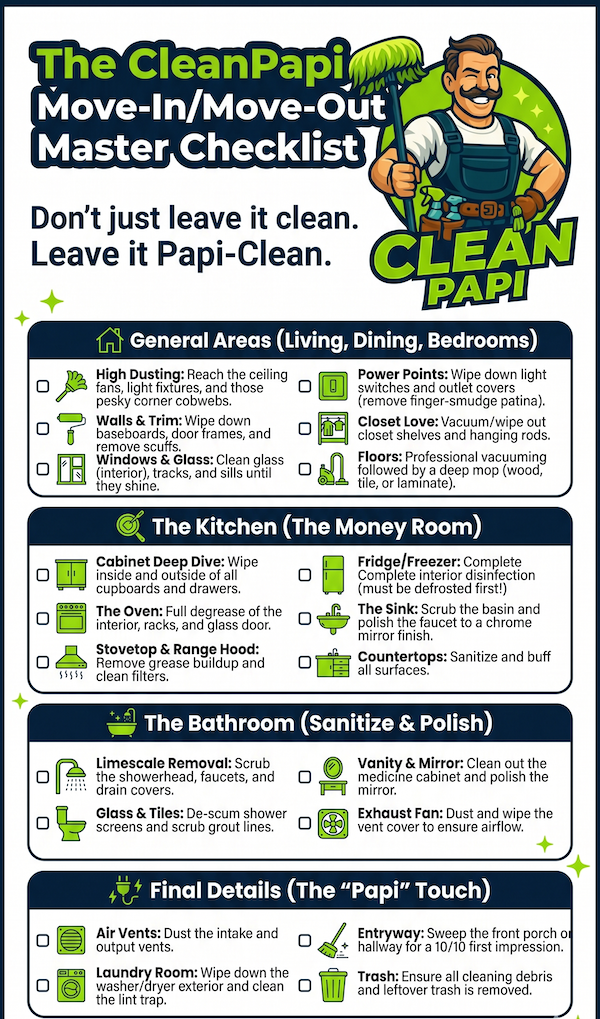
Print this. Use it. Or hand it to whoever you hire. This is the actual checklist our team uses on every Toronto move-out clean.
Kitchen — Plan 2.5 to 3 Hours
The kitchen is where 70% of deposit deductions happen. We always start here.
- Empty all cabinets and drawers. Wipe interiors and exteriors.
- Clean inside the oven. We use a Waitbird steam cleaner plus a manufacturer-approved oven cleaner. Let it sit overnight if it's been a while.
- Pull the stove out and clean behind and underneath. There's pasta from 2023 back there. Trust me.
- Stovetop, burners, drip pans, range hood, and the stove vent filter (this is the one most cleaners skip — it's the one landlords always check).
- Empty and clean the fridge and freezer. Pay specific attention to the rubber gasket around the door.
- Defrost the freezer if needed.
- Clean the microwave inside and out.
- Run a dishwasher cleaning cycle. Wipe the seal and clean the filter at the bottom.
- Scrub the sink, the taps, and the drain. Bar Keepers Friend works wonders on stainless steel.
- Wipe all countertops, backsplash, and tile grout.
- Polish stainless appliances.
- Wash floors, paying attention to corners and edges.
Bathroom — Plan 1.5 to 2 Hours
Second-most-common deposit killer. Mould, soap scum, and limescale are the three demons.
- Toilet inside, outside, base, and the wall behind it.
- Descale the showerhead and faucets. A vinegar bag tied around them overnight does the job.
- Scrub tile grout, shower walls, and the tub.
- Treat any visible mould with hydrogen peroxide. Re-caulk if discoloration won't lift.
- Mirror, glass, and the medicine cabinet interior.
- Vanity, drawers, and inside the cabinet under the sink (don't skip this — it's a Clean Papi signature spot).
- Hair out of drains. Use drain cleaner if water is slow.
- Scrub the floor, especially the grout lines and corners.
- Wipe the exhaust fan grille. Toronto landlords love checking this one.
- Replace any burnt-out bulbs.
Bedrooms — Plan 30–45 Minutes per Room
- Dust and wipe baseboards, including behind the bed.
- Wipe door frames, doors, and the top of the closet door frames (yes, the flat edge on top — see earlier).
- Vacuum thoroughly with a HEPA vacuum (we use Bissell). If carpets are stained or smell of pets, professional carpet cleaning is worth the $150.
- Clean inside windows, window tracks, and blinds.
- Patch nail holes with spackle. Don't paint unless your lease specifies it.
- Wipe doors, handles, and switch plates.
- Empty all closets, including the floor and the shelf above.
Living Room — Plan 45 Minutes
- Dust and wipe baseboards behind any furniture you've moved.
- Light fixtures and ceiling fans. Take down domed covers — there will be dead flies.
- Vacuum carpets and rugs. Move the couch and clean underneath.
- Mop hardwood with a hardwood-safe cleaner.
- Wipe the inside of the front door, including any window panels.
- Clean the entryway tile, especially the grout.
Laundry — Plan 30 Minutes
- Run an empty hot cycle on the washing machine with vinegar or a washer cleaner.
- Wipe the rubber gasket of the front-loading washer (mould lives here).
- Lint trap in the dryer. Clean the vent if you can access it.
- Wipe shelves and the floor.
The "Forgotten Five" — Most Common Skipped Spots
These are the ones where I lose deposits in my own move-out:
- Top of the kitchen cabinets (greasy dust, very visible from the height of a tall landlord).
- Behind the toilet.
- Window tracks.
- The exhaust fan grille in the bathroom.
- The dome covers on light fixtures. Add 30 minutes for these. They're worth the time.
Patio / Balcony / Storage Locker
If you have outdoor space or a storage locker — and most Toronto condo dwellers do — this is part of your tenancy. I have personally seen tenants forget the storage locker on moving day. The landlord finds it, charges removal, and no one is happy.
- Sweep the floor.
- Wipe railings and glass panels.
- Empty everything from the storage locker, even the seasonal stuff you're "definitely going to use."
- Clean any planters or BBQ residue.
Final Walkthrough
Before you hand back the keys:
- Take dated, time-stamped photos of every room.
- Walk through with the landlord with this checklist in hand.
- Confirm your forwarding address in writing.
- Get a signed copy of the inspection from the landlord. That signed inspection is your insurance against any future deposit dispute.
When DIY Works and When It Doesn't
Here's the honest call. I can't tell you whether to DIY your Toronto move-out clean without knowing your situation. So here's the framework I use when clients ask me:
DIY works if:
-
You're moving out of a small unit (studio, 1-bedroom).
-
The unit is already in mostly good condition.
-
You have at least a full day, ideally two, to do this properly.
-
You own (or can borrow) a HEPA vacuum, a good mop, oven cleaner, and the right products.
-
Your moving timeline isn't already at the breaking point.
-
Your deposit isn't huge. Hire a pro if:
-
You're in a 2+ bedroom unit, especially with multiple bathrooms.
-
You've lived there 2+ years and the unit needs serious deep work.
-
You have pets or you've smoked indoors.
-
Your last-month's-rent deposit is significant — like, several thousand dollars.
-
You're moving cities, provinces, or countries and your bandwidth is shot.
-
You have kids or work that doesn't pause for moving week.
-
Your lease specifically requires "professional cleaning" in writing (more leases include this clause every year). A Clean Papi move-out clean for a 2-bedroom Toronto unit runs $300–$600 depending on size and condition. For a 3-bedroom or a heavily-soiled unit, plan for $500–$900. Almost every time, it's cheaper than the deposit you'd lose.
Why a Generic "Cleaning Service" Often Doesn't Cut It for Move-Outs
I learned this the hard way working in this industry. A regular cleaning service is not the same thing as a move-out cleaning service. The scope is different. The time required is different. The product set is different.
The cheap "$199 move-out special" you see advertised on Kijiji or Facebook Marketplace is almost always a 2-hour wipe-down that doesn't touch baseboards, ovens, fridges, window tracks, or any of the spots landlords actually inspect. You'll pay for the clean and still lose your deposit. I've had three clients in the past six months who came to Clean Papi after exactly this experience.
When you're hiring for a move-out, ask for:
- A written checklist of what's included.
- Confirmation that inside-the-oven, inside-the-fridge, baseboards, light fixtures, window tracks, and behind-furniture are all included (not "available as add-ons").
- Before-and-after photos. We document every Clean Papi move-out clean. Photos go in our system. You can request them. They protect both you and us.
- A CGL insurance certificate ($2 million coverage is standard). If the cleaner damages the unit during the clean, you don't want to be the one explaining that to your landlord.
Toronto Condo-Specific Move-Out Tasks
If you're moving out of a Toronto condo —Downtown Toronto - Liberty Village, CityPlace, Yonge & Eg, anywhere with a concierge — there are extras the suburbs don't deal with.
- Book the elevator. Most downtown towers require 2–4 weeks' notice and a refundable deposit. Don't leave this to the day before.
- Check building hours. Many buildings restrict moves to weekday 9–5 only. Some don't allow weekend moves at all.
- Empty the storage locker. I cannot stress this enough. Empty the storage locker. The number of clients who've called us in a panic at 7 p.m. on moving day because they forgot the locker is in the double digits.
- Clean the balcony glass. City pollution, bird droppings, and dust collect fast on Toronto high-rise balconies. It's part of the unit.
- Touch up the inside of the front door. Moving boxes scuff it. Spackle and a damp cloth fix most of it.
- Return all fobs, keys, and access cards. Get a signed receipt from concierge.
- Notify property management of your move-out date. They'll arrange the inspection.
Call Clean Papi if Any of This Sounds Like Your Move
If you're looking at moving day and any of the following are true, hiring a professional move-out clean is the highest-leverage decision you'll make this week:
- You haven't deep-cleaned the place in 6+ months (or ever).
- You have pets.
- Your deposit is meaningful enough to fight for.
- Your landlord has a reputation for white-glove inspections.
- Your lease requires "professional cleaning" in writing.
- You're physically and emotionally exhausted from the move itself. We do move-out cleans across Toronto and the GTA. Every clean is documented with before-and-after photos. CGL certificate on file. Bissell HEPA vacuums, Waitbird steam cleaners, Bar Keepers Friend on the stainless. Same checklist I built after losing my own $500.
Request a move-out cleaning quote and we'll call you the same day with a price range based on your unit and condition. The final invoice is calculated on actual time + materials + a 35% margin — usually less than the initial estimate.
— Nathan Founder, Clean Papi
Frequently Asked Questions
How much does move-out cleaning cost in Toronto in 2026?
A move-out clean for a 2-bedroom Toronto unit typically costs $300–$600. A 3-bedroom or heavily-soiled unit runs $500–$900. Pricing depends on square footage, condition, and add-ons like carpet cleaning. Most reputable Toronto cleaning companies offer flat-rate quotes after a brief phone or photo assessment.
Can my Toronto landlord keep my last month's rent deposit for cleaning?
No. Under Ontario's Residential Tenancies Act, the last month's rent deposit can only be applied to unpaid rent — not to cleaning or damages. If a landlord wants to recover cleaning costs, they must apply to the Landlord and Tenant Board with documented evidence. In practice, many landlords still try, and many tenants pay rather than fight.
What do Toronto landlords specifically check during a move-out inspection?
Toronto landlords routinely check the fridge gasket, stove vent filter, top of closet door frames, oven door seal, behind the toilet, dishwasher and washing machine gaskets, window tracks, dryer lint trap, baseboards behind furniture, and light fixture domes. These are the spots most tenants miss and where most deposit deductions happen.
Do I have to professionally clean my apartment when I move out in Ontario?
You're legally required to leave the unit in the same condition as move-in, minus ordinary wear and tear. "Professional cleaning" isn't always required by law, but many leases specify it. Even when not required, hiring a pro is often cheaper than losing part of your deposit.
How long does professional move-out cleaning take in Toronto?
A Clean Papi team of two typically completes a move-out clean in 4–8 hours depending on size and condition. A 1-bedroom condo may take 4–5 hours. A 3-bedroom home in poor condition can take a full day. Larger teams shorten the timeline.
Should I clean before or after the movers come?
After. Cleaning before the furniture is out means you'll redo the floors, baseboards, and behind-furniture spots once everything's gone. Schedule the clean for the day your movers finish, or the morning after.
Do I need professional carpet cleaning when moving out in Toronto?
Only if your lease specifies it, or if the carpets are heavily stained, smell of pets or smoke, or show wear beyond normal use. Professional carpet cleaning runs $150–$300 for a 2-bedroom. It's almost always worth the cost to avoid a deposit dispute.
What happens if I don't clean my Toronto rental properly?
Your landlord can document the condition with photos and apply to the Landlord and Tenant Board for cleaning costs. They cannot legally withhold your last month's rent — that's not allowed in Ontario — but a successful Board application can result in a judgment that affects credit and future rental applications.
Should I tip my move-out cleaning team?
Tipping is appreciated but not required. The standard for one-time deep or move-out cleans is 15–20%. A positive Google or HomeStars review is also meaningful — it directly helps the cleaners' livelihood.
Need Professional Help?
Let Toronto's most trusted cleaning team handle the dirty work. Get an instant price estimate — no phone call required.